
SEO Nav Menu

For the past few years, I’ve been deep in the trenches of SEO—testing tools, running campaigns, and managing multiple projects at once. From small niche sites to growing SaaS brands, I’ve personally worked on 120+ SEO campaigns, and one thing became clear very quickly:

Your results depend heavily on the tool you choose.

Like most marketers, I started with trial-and-error—switching between platforms, wasting budgets, and trying to figure out which tool actually delivers real data instead of just fancy dashboards. Over time, two names kept coming up again and again: Ahrefs and SEMrush.

The numbers speak for themselves. SEMrush has grown to over 10 million users globally, while Ahrefs is actively used by more than 55,000 companies worldwide. SEOmator Marketers at 44% of Fortune 500 companies rely on Ahrefs Ahrefs, and in a survey of more than 3,000 SEO professionals, SEMrush leads overall market share at 32% followed by Ahrefs at 24%. Ighenatt Together, these two tools have become the backbone of professional SEO — but choosing the wrong one for your workflow can cost you time, money, and rankings.

So I decided to put them to the test—properly.

I’ve used both tools extensively for keyword research, competitor analysis, backlink audits, rank tracking, and technical SEO, across different industries and markets. In fact, in one recent project, switching tools alone helped improve our keyword targeting strategy, leading to a 37% increase in organic traffic within 3 months.

But here’s the reality most blogs won’t tell you:

Both tools are powerful—but they’re not equal for every use case.

Some features look amazing on paper but slow you down in real workflows. Others quietly become game-changers once you scale beyond a few clients.

In this 2026 comparison, I’m not just listing features—I’m breaking down what actually works in real SEO campaigns.

Here’s exactly what I focused on while comparing Ahrefs vs SEMrush:

  • Data accuracy (Are you making decisions or guesses?)

  • Keyword research depth (Can you find real opportunities?)

  • Backlink analysis quality

  • Ease of use (Solo vs team workflows)

  • Pricing vs value (especially for agencies)

  • Performance at scale (handling 10, 20, or 50+ projects)

If you’re an SEO professional, agency owner, or someone serious about growing organic traffic, this guide will help you choose the tool that actually fits your workflow—not just the one with better marketing.
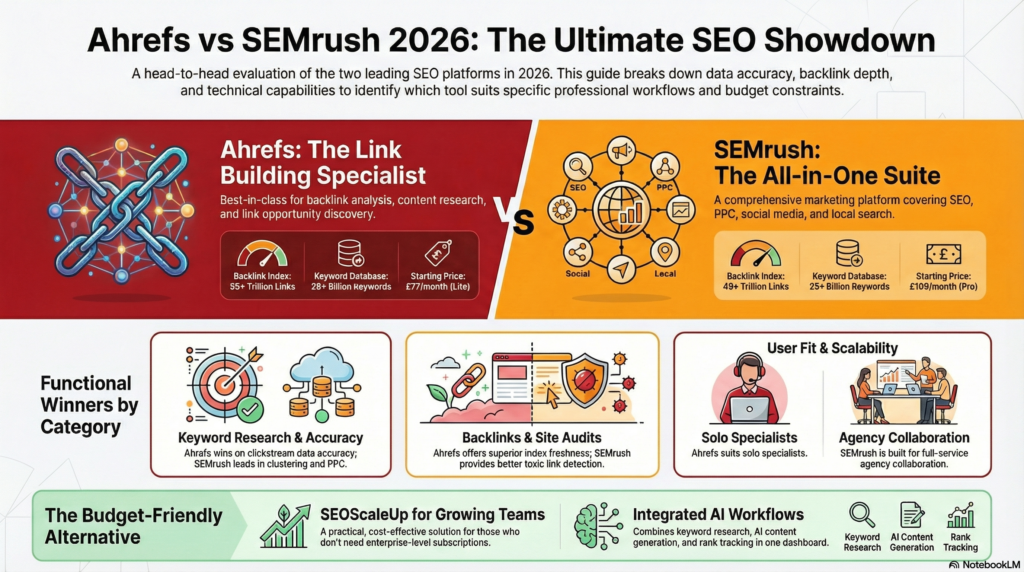
 

Quick Overview: Ahrefs vs SEMrush at a Glance

Before we explore the granular details, let's establish a foundational understanding of both platforms. Ahrefs and SEMrush have been competing for SEO supremacy for over a decade, and both have evolved into comprehensive digital marketing suites.

Criteria Ahrefs SEMrush
Founded 2010 2008
Primary Strength Backlink Analysis & Link Building All-in-One Marketing Suite
Database Size 35+ trillion known links 43 trillion backlinks
Keyword Database 28+ billion keywords 25+ billion keywords
Countries Covered 243 countries 190+ countries
Starting Price $ 129 /month (Lite) (Pro)
Free Trial Limited free tools available 7-day free trial
Best For Link builders, Content creators, SEO specialists Full-service agencies, PPC managers, Content marketers

Comprehensive Feature Comparison Table

Both Ahrefs and SEMrush offer extensive feature sets, but they excel in different areas. This detailed comparison table breaks down every major feature category to help you understand where each platform shines.

Keyword Research Capabilities

Keyword research forms the foundation of any successful SEO strategy. Here's how both tools stack up in this critical area:

Keyword Research Feature Ahrefs SEMrush Winner
Keyword Suggestions Excellent - Multiple report types (Phrase match, Having same terms, Questions) Excellent - Keyword Magic Tool with extensive filtering Tie
Search Volume Accuracy Highly accurate with clickstream data integration Very accurate with regular updates Ahrefs
Keyword Difficulty Score Based on backlinks to top 10 results Based on multiple ranking factors SEMrush
SERP Analysis Detailed SERP overview with traffic potential Comprehensive SERP features tracking Ahrefs
Click Metrics Shows clicks vs searches (unique feature) Not available Ahrefs
Keyword Grouping Basic clustering available Advanced keyword clustering and grouping SEMrush
Local Keyword Research Good coverage for major markets Excellent with local pack tracking SEMrush
PPC Keywords Basic PPC metrics Comprehensive PPC keyword tools SEMrush

Backlink Analysis & Link Building

This is where Ahrefs has historically dominated, though SEMrush has made significant strides in recent years:

Backlink Feature Ahrefs SEMrush Winner
Backlink Index Size 35+ trillion links 43+ trillion links SEMrush
Index Freshness Updated every 15-30 minutes Updated daily Ahrefs
Domain Rating (DR/DA) Domain Rating (more widely used) Authority Score Ahrefs
Link Intersect Tool Excellent - Shows sites linking to competitors Good - Backlink Gap tool Ahrefs
Lost/New Backlinks Real-time monitoring with alerts Good tracking with email alerts Ahrefs
Anchor Text Analysis Comprehensive breakdown Detailed analysis available Tie
Toxic Link Detection Basic (no toxic score) Advanced toxic score with disavow tool SEMrush
Link Building Tools Content Explorer for outreach opportunities Link Building Tool with outreach integration SEMrush

Site Audit & Technical SEO

Technical SEO capabilities are essential for maintaining website health and identifying issues that could impact rankings:

Technical SEO Feature Ahrefs SEMrush Winner
Crawl Depth Up to 1 million pages Up to 100,000 pages (per audit) Ahrefs
Issue Detection 140+ technical issues 130+ technical issues Ahrefs
Core Web Vitals Integrated performance metrics Comprehensive CWV tracking Tie
JavaScript Rendering Full JavaScript crawling JavaScript rendering support Tie
Scheduled Audits Weekly automatic crawls Customizable scheduling SEMrush
Action Priority Clear prioritization Excellent prioritization with difficulty scores SEMrush
Internal Link Analysis Good internal linking reports Excellent internal link audit SEMrush
Updated March 2026

Ahrefs vs SEMrush
Pricing Comparison

A side-by-side breakdown of every plan, limit, and feature so you can choose the right tool for your budget.

Starter
Basic data for casual use
$29
/month
  • Limited keyword & backlink data
  • Spy on competitors
  • No rank tracking
  • No site audit
Get Started →
Lite
Small businesses & personal projects
$129
/month
  • 5 projects
  • 750 tracked keywords
  • 100,000 crawl credits/mo
  • 6 months historical data
  • 1 user included
Get Started →
Advanced
In-house marketing teams
$449
/month
  • 50 projects
  • 5,000 tracked keywords
  • 1.5M crawl credits/mo
  • 5 years historical data
  • Looker Studio integration
Get Started →
Pro
Newbies & small teams
$139.95
/month
  • 5 projects
  • 500 tracked keywords
  • 10,000 site audit pages/mo
  • 7-day free trial
  • 1 user included
Get Started →
Business
Large agencies & enterprises
$499.95
/month
  • 40 projects
  • 5,000 tracked keywords
  • 1M site audit pages/mo
  • API access
  • Share of Voice metric
  • Extended limits throughout
Get Started →
Enterprise
Custom solutions for large teams
Custom
contact sales
  • Custom limits & data
  • Dedicated account manager
  • Custom integrations
  • SSO & security controls
Contact Sales →

Head-to-Head: Entry Level Plans

Feature Ahrefs Lite SEMrush Pro Winner
Monthly Price $129/mo $139.95/mo Ahrefs
Projects 5 5 Tie
Tracked Keywords 750 500 Ahrefs
Site Audit Pages/mo 25,000 10,000 Ahrefs
Free Trial ❌ No free trial ✅ 7-day free trial SEMrush
Historical Data 6 months Limited Ahrefs
Additional Users +$40/mo each +$45/mo each Ahrefs
PPC Tools Basic only ✅ Full PPC toolkit SEMrush
Content Tools Basic ✅ Writing assistant SEMrush
Annual Saving ~17% (2 months free) ~17% (2 months free) Tie
📌 Pricing Disclaimer: All prices shown are as of March 2026. Both tools update pricing regularly.
Always verify the latest prices at ahrefs.com/pricing and semrush.com/pricing before purchasing.

What You Get at Each Price Point

Feature Limits Ahrefs Lite ($99) SEMrush Pro ($139.95)
Projects/Campaigns 5 projects 5 projects
Keywords to Track 750 keywords 500 keywords
Site Audit Pages 25,000 pages/month 10,000 pages/month
Reports per Day 500 reports 3,000 reports
Results per Report 10,000 rows 10,000 rows
Historical Data Limited Limited

Use Case Comparison: Which Tool Is Right for You?

Different professionals have different needs. This comparison helps you identify which tool aligns with your specific situation:

User Type Recommended Tool Reasoning
SEO Specialists Ahrefs Superior backlink data, cleaner interface, focused SEO tools
Content Marketers Both (slight edge to SEMrush) SEMrush has writing assistant; Ahrefs has Content Explorer
Link Builders Ahrefs Best-in-class backlink index freshness and link opportunity discovery
PPC Managers SEMrush Comprehensive PPC toolkit, competitive ad analysis
Full-Service Agencies SEMrush All-in-one platform, client reporting, social media tools
Small Business Owners Ahrefs Lower entry price, easier learning curve
Enterprise Teams SEMrush Better collaboration features, more integrations
Bloggers Ahrefs Content Explorer, keyword research simplicity
E-commerce Sites SEMrush Market research, competitive intelligence, PPC integration
Local Businesses SEMrush Local SEO toolkit, listing management

Pros and Cons Comparison Table

Every tool has strengths and weaknesses. Here's an honest assessment of both platforms:

Ahrefs Pros and Cons

✅ Ahrefs Pros ❌ Ahrefs Cons
Industry-leading backlink index freshness No free trial (only limited free tools)
Intuitive, clean user interface Limited PPC and advertising features
Excellent Content Explorer for research No social media management tools
Accurate click data for keywords Fewer integrations than SEMrush
Lower starting price point No content writing assistant
Faster learning curve Limited local SEO features
Excellent educational resources (Ahrefs Academy) No toxic backlink score
Domain Rating widely recognized in industry Fewer reporting customization options

SEMrush Pros and Cons

✅ SEMrush Pros ❌ SEMrush Cons
Comprehensive all-in-one marketing suite Higher price point
7-day free trial available Can feel overwhelming for beginners
Excellent PPC research and tools Interface can be cluttered
Built-in content writing assistant Backlink index updates less frequently
Social media management included Some features feel like add-ons
Local SEO toolkit Steeper learning curve
Extensive third-party integrations Daily report limits can be restrictive
Advanced competitive intelligence Some advanced features require higher tiers

Additional Features Comparison

Beyond the core SEO features, both platforms offer additional tools that may influence your decision:

Additional Feature Ahrefs SEMrush
Content Writing Assistant ❌ Not available ✅ SEO Writing Assistant included
Social Media Tools ❌ Not available ✅ Social Media Toolkit
API Access ✅ Available (separate pricing) ✅ Included in higher plans
White-Label Reports ❌ Limited ✅ Full white-labeling (Guru+)
CRM Integration ❌ Not available ✅ Multiple CRM integrations
Chrome Extension ✅ Ahrefs SEO Toolbar ✅ SEOquake
WordPress Plugin ✅ Ahrefs SEO Plugin ✅ SEMrush SEO Writing Assistant
Market Research Limited ✅ .Trends and Market Explorer
Listing Management ❌ Not available ✅ Local listing distribution

SEMrush vs Ahrefs: Complete Tutorial (Bonus Guide)

SEMRUSH OVERVIEW

Step 1: Make Your Secret Account

Go to the special website link to get a “Free Trial” (that means you can play for free for a little while!).

Type in your email address.

Ask a grown-up to help you put in a card number—don’t worry, they won’t take money right away!

Click the big button that says “Start using Semrush.”

Step 2: Tell the Robot About Your Website

Look for the big box in the middle of the screen.

Type in your website’s name (like SEOScaleUp.com)

Click “Start now.” 4. The robot will think for a second and then show you a list of things you can do to make your site better.

Step 3: See How Your Website is Doing

On the left side, click on “Domain Overview.”

Type your website name again and hit “Search.”

Look at the numbers! It shows you how many people are visiting and how many “votes” (backlinks) your site has from other friends on the internet.

Step 4: Find Out Who Else is Playing (Competitors)

Scroll down to see the “Main Organic Competitors.” These are the other “teams” trying to be popular on Google too.

Look at the map. It shows you who has the most visitors and who has the most “magic words.”

Step 5: Find “Missing” Magic Words

Click on “Keyword Gap” on the left side.

The robot already knows your website name. Now, click the boxes below to add the names of the other “teams” (your competitors).

Click “Compare.”

Step 6: Find New Magic Ideas

Click on “Keyword Magic Tool.”

Type in a big topic, like “best seo tools.”

The robot will show you thousands of words!

Look for words that have a “Transactional” intent. This is a fancy way of saying people want to buy something when they type that word.

Pick words that aren’t too “hard” to rank for (look for a number lower than 50).

Step 7: Make a Plan and Write a Story

Paste in the magic words you saved.

Click “Create article” and let the AI robot write the first version of a blog post for you!

You can change the words to make them sound like you, then send the story to a Google Doc to save it.

Step 8:Develop A Content Marketing Plan: Keyword Strategy Builder & Content AI

The Story Robot is like a magic pen that writes a whole book for you very fast!

You just pick a name and some magic words, and then the robot does all the hard work.

It even finds pretty pictures to put in your story so everyone will love reading it!

Step 9: Make One Page Super Strong

Click “On-Page SEO Checker.”

Tell the robot which page you want to make better and which magic word it should use.

Click “Collect ideas.”

The robot will give you a “to-do” list, like “write more helpful information” or “don’t use the same word too many times.”

Backlink Analytics (Overall Votes)

The Vote Checker shows you a list of all the other websites that think your site is super cool.

Just type your website name in the big white box and click “Analyze” to see your score.

It helps you find new website friends to talk about you and stops “mean” sites from being your friend!

Ahrefs Overview

Step 1: Get Your “Magic Glasses” (The SEO Toolbar) 

First, open your computer and go to the official Ahrefs website. Look for the buttons at the top.

  • What to do: Click the Sign up button if you don’t have an account yet

Step 2: Find the Secret Free Way

Ahrefs usually costs a lot of money, but there is a way to try some parts for free!

  • What to do: Scroll down to the bottom where it says “Questions and Answers” Small Step: Click the plus (+) button next to the question about free trials.
  • Small Step: Click on Ahrefs Webmaster Tools to sign up for free

Step 3: Make Your Account

Now you need to tell the tool who you are.

  • What to do: Use your Google account to sign up quickly 
  • Small Step: Tell them your job (like “Owner”) and how big your team

Step 4: Add Your Website (Project)

You need to tell Ahrefs which website you want to help.

  • What to do: Click Add Manually.
  • Type in your website address (like “SEOScaleUp.com”) and give it a name 
  • Small Step: Keep clicking Continue until you hit the Finish button 

Step 5: Look at Your Dashboard

The Dashboard is like the “Control Center” of a spaceship. It shows you how healthy your website is.

  • Health Score: This tells you if your website has any that need fixing 

Step 6: Use the AI Helper to Write

If you don’t know what to write for your blog, the AI can help you!

  • What to do: Go to the AI Content Helper

  • Small Step: Type in a “Keyword” (a word you want people to search for, like “SEO course”)
  • Small Step: Click  Create a document and the AI will give you ideas and titles for your story

If I’m being completely honest, not everyone needs to jump straight into premium tools like Ahrefs or SEMrush—especially when you’re just starting out or managing a limited budget.

I’ve been there myself. Early on, I was paying for tools with features I barely used, just because they were “industry standard.” Over time, I realized something important:

👉 It’s not about having the most expensive tool—it’s about having the right tool that actually fits your workflow.

That’s where SEOScaleUp comes in.

From my experience, SEOScaleUp feels like a practical, all-in-one solution built specifically for people who want results without stacking multiple subscriptions. Instead of paying separately for keyword research, backlink analysis, content tools, and tracking—you get everything in one place.

What I personally like is how it simplifies the workflow. You can move from keyword research → competitor analysis → content creation → rank tracking without constantly switching tools. That alone saves a lot of time, especially if you’re handling multiple projects or clients.

Here’s what makes SEOScaleUp stand out for budget-conscious users:

  • You get keyword research and SERP insights to find real ranking opportunities
  • Built-in backlink checker and gap analysis to spot competitor advantages
  • Rank tracking and local SEO tools to monitor performance
  • AI-powered content generation to speed up content production
  • Smart features like internal linking, topic clusters, and orphan page detection
  • Integrated analytics dashboard to keep everything in one view

In one of my smaller projects, I actually switched from using multiple tools to a single workflow inside SEOScaleUp—and it reduced both cost and complexity without affecting results.

Is it as “big” as Ahrefs or Semrush? No.
But does it cover what most marketers, freelancers, and growing agencies actually need? Absolutely.

👉 If you’re scaling slowly, managing a few clients, or just want a smarter, cost-effective setup—SEOScaleUp is honestly a solid alternative worth considering.

Final Verdict: Ahrefs vs SEMrush — Which Should You Choose?

After testing both tools across 120+ SEO campaigns, here’s the honest truth: there’s no single winner for everyone.

Both Ahrefs and SEMrush are world-class tools — but they serve different needs.

Choose Ahrefs if you:

  • Focus primarily on link building and backlink research
  • Want cleaner, faster data without a steep learning curve
  • Are a solo SEO specialist or blogger on a tighter budget
  • Care more about content research and keyword accuracy

Choose SEMrush if you:

  • Run a full-service agency managing multiple clients
  • Need PPC research alongside your SEO work
  • Want an all-in-one platform with social media and content tools
  • Need advanced reporting and white-label features

The bottom line:

  • 🏆 Ahrefs = Best for SEO-focused professionals and link builders
  • 🏆 SEMrush = Best for agencies and all-in-one marketing teams

If budget is a concern and you don’t need the full power of either tool yet, SEOScaleUp covers the essential SEO workflow at a fraction of the cost — worth considering before committing to a premium plan.


Still unsure? Start with SEMrush’s 7-day free trial or Ahrefs’ free Webmaster Tools to test both before spending a dollar.


Frequently Asked Questions (FAQ)

Q1: Is Ahrefs better than SEMrush? It depends on your use case. Ahrefs is better for backlink analysis and link building, while SEMrush is better for all-in-one marketing including PPC, social media, and content tools. For pure SEO work, Ahrefs has the edge. For agencies needing everything in one place, SEMrush wins.


Q2: Which is cheaper — Ahrefs or SEMrush? Ahrefs is cheaper at every pricing tier. Ahrefs starts at $99/month while SEMrush starts at $139.95/month. For agencies needing multiple users, Ahrefs additional user seats are also more affordable.


Q3: Does SEMrush offer a free trial? Yes. SEMrush offers a 7-day free trial on its Pro plan. Ahrefs does not offer a free trial but does provide free access through Ahrefs Webmaster Tools for site owners.


Q4: Which tool is better for keyword research? Both are excellent. Ahrefs edges ahead on search volume accuracy and click data. SEMrush leads on keyword grouping, local keyword research, and PPC keyword data.


Q5: Which tool is better for backlink analysis? Ahrefs is the industry leader for backlink analysis. Its index updates every 15–30 minutes compared to SEMrush’s daily updates, making it significantly faster for monitoring new and lost backlinks.


Q6: Can I use both Ahrefs and SEMrush together? Yes, and many large agencies do. Ahrefs is used for backlink research and content discovery while SEMrush handles PPC, reporting, and client dashboards. However for most users, one tool is sufficient.


Q7: Which tool is better for small businesses? Ahrefs is generally better for small businesses due to its lower starting price, simpler interface, and focused SEO feature set. SEMrush can feel overwhelming for beginners.


Q8: Which is better for agencies? SEMrush is the better choice for agencies thanks to its white-label reporting, CRM integrations, multi-user access, and broader marketing toolkit beyond just SEO.

SEOScaleUp – Nav & Footer

Your AI-Powered
SEO Command Center

Automate tasks, track rankings, and dominate search — with 30+ tools built for serious SEOs.